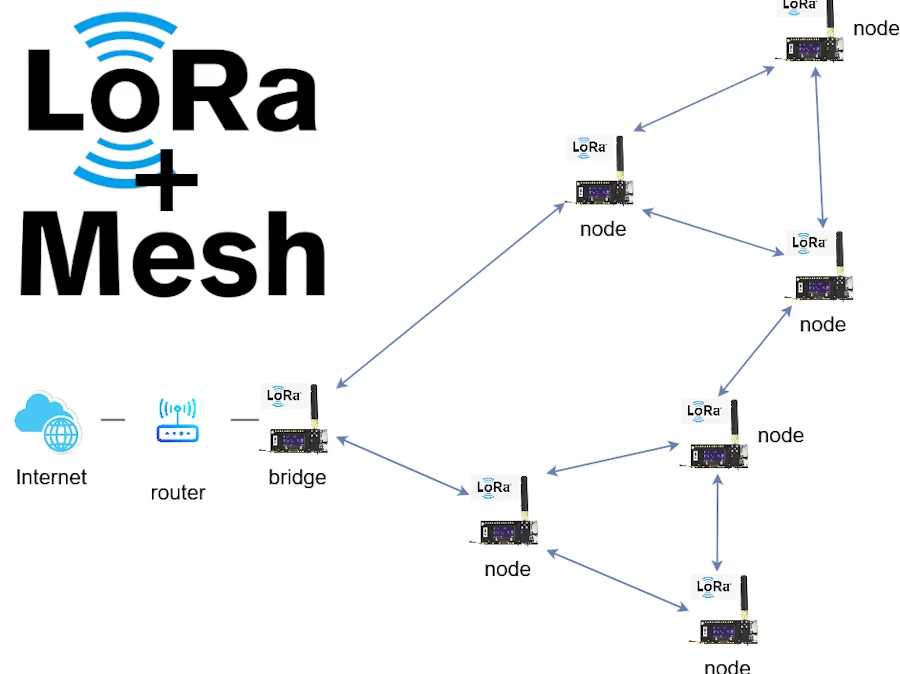
I’m pretty new to networking concepts, so apologies if these are basic questions!
I’m working on a project to deploy sensor nodes across a large, remote forest area (roughly 10km radius), well beyond cellular coverage.
Objective:
Each node will send its data (up to 1MB at a time, 1-2 times per day) through a mesh network, hopping from node to node until it reaches a base station located where there’s cellular coverage. Battery/solar operation is crucial; visiting each node daily to change batteries would be impossible in this environment.
I’ve included a reference image showing what I’d like to achieve using Wi-Fi HaLow for better data rates and mesh reliability.
Is mesh networking (802.11s, or similar) supported directly on the MM6108 SoC (or similar Morse Micro chips)?
I prefer using standalone SoC modules at each node, instead of a Linux single-board computer.
Where should I start if I’m new to networking and HaLow mesh?
Are there any beginner-friendly reference documents, setup guides, or demo projects for deploying multi-hop mesh using Morse Micro dev kits or modules? Sample workflows or video tutorials would help a lot.
Specific kit recommendation:
I’m looking at the MM6108 kit for prototyping. Can it operate as a mesh node out of the box, or do I need extra hardware/firmware?
Any advice, product clarification, would be hugely appreciated. Thanks a lot!
So generally speaking, you objective is possible! And we have users deploying networks like this today. However, some caveats as per your more specific asks:
Is mesh networking (802.11s, or similar) supported directly on the MM6108 SoC (or similar Morse Micro chips)?
We don’t support standalone mode (user running code directly) on our MM6108 SoC. This is a “SoftMAC” part so there needs to be a host processor to drive it. Our microcontroller stack (eg software targeting an STM32), does not currently support 802.11s-style mesh. So this will limit you to Linux based devices.
Where should I start if I’m new to networking and HaLow mesh?
We have a detailed guide for setting up 802.11s mesh using HaLowLink1s available here. Recommend the HaLowLink1’s as a start point. However, they may not meet your requirements for power, in which case you may want to look at MT7628 based products from Heltec or AsiaRF. While still a Linux processor, the MT7628s are reasonably low power that they will run off a solar + battery supply .
I’m looking at the MM6108 kit for prototyping. Can it operate as a mesh node out of the box, or do I need extra hardware/firmware?
Which specific MM6108 based kit are you looking at? Strongly recommend the HaLowLink1 to get started experimenting, and optimise for your constraints later as required.
Thanks for bringing up this topic. I’m also starting to develop mesh network for end-node / smart meter using WiFi Halow. Basically it is similar to LoRa mesh or WiSun RF network but I don’t know how to start and what protocol should be use for this kind of mesh network, since it will run on MCU like ESP32/STM32. Is 802.11s suitable for this purpose? If not, do you have recommendation what protocol or stack to use?
Are you still looking for such product, actually we already implemented what you want. We have solar powered node with Heltec HT-HC33(ESP32S3 + MM6108) work as mesh client, has I2C/UART/RS485 interface, with 5V power supply. It can integrate with various mesh node with Morse Micro chips.
By the way, now we are working on nRF54L15 MCU + MM6108 Mesh node, it can lower the power consumption to 0.2W where as current Heltec HT-HC33 is around 0.5W. HT-H7608 >1W
I am actually looking for such a product. Intent is to use smaller, low powered devices to extend a mesh but have heavier devices such as pis on the edges with more sensor capability. I’ve done a fair bit of meshing with raspberry pis using 6108 based hats with great successbut have not successfully added any embedded devices to an 802.11s secured with WPA3. Boards I’ve looked at are the XIAO and Heltec. I am not as comfortable programming these devices though.
I’m so glad to hear somebody is doing similar thing. Actually I evaluated both, Heltec HT-HC33 and Seeed nRF54L15 sense + Seeed WiFi halow module. Heltec is good to use as a dev board, it has plenty of memory and easy to write firmware, the drawback is more power hungry, around 0.5w. So we use it as our prototype. We are developing our own base board similar to Seeed, the power consumption is around 0.2w, can save a lot of power.
completely agree with you that there are so much pain to write firmware for MCU. So we are making software defined IoT, so we build a middleware to join the hardware together, so software developers can program it as IO device with API.